Dust2 may be one of the most iconic maps in the multiplayer FPS universe. When Dust2 released ~25 years ago, it quickly became the gold-standard for map design, setting the bar and formula to a position that permanently changed how Counter-Strike maps were designed.
Let’s discuss why.
When people ask me how to get into Level Design, I tend to find myself always giving them the same answer: “If you can understand and break-down the function and reasoning for every part of Dust2, you’re on your way to understanding Level Design”.
Flow, line of sight, readability, versatility, simplicity, no overpowered locations… just some of the things that first come to mind when asking “what makes a good multiplayer map?”
There’s no fat on Dust2. Every part of the map serves a purpose. Every crate, barrel, path and object has a reason for being there, no more, no less. It’s also a map that has gone through small iterations and improvements over the past 25 years, demonstrating there’s no such thing as “perfect” – there’s always ways to tweak and improve.

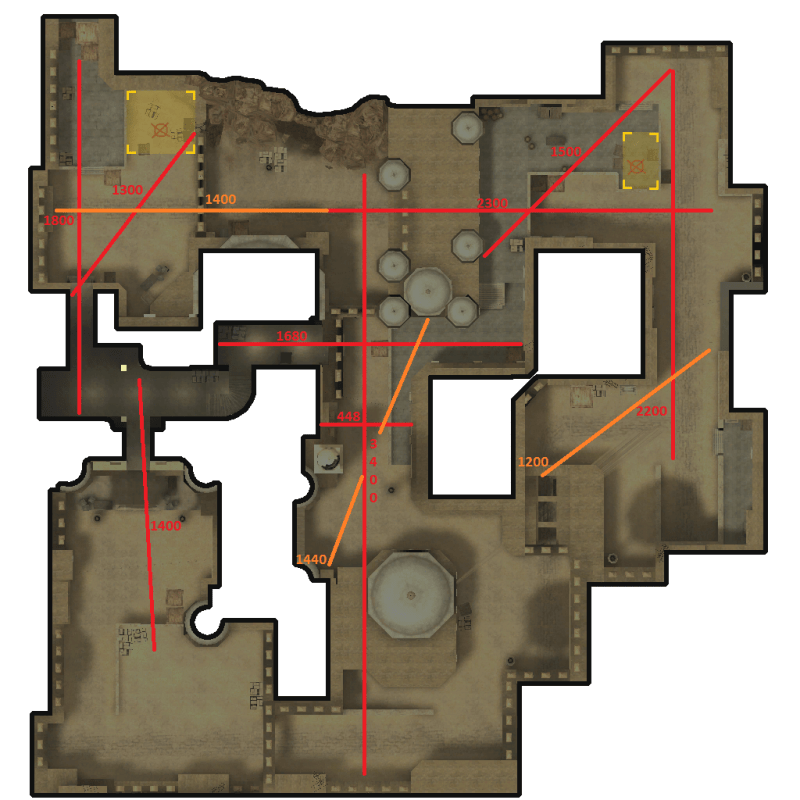
If you look at a top-down view of the layout of Dust2, you’ll see that it’s essentially a square map – but with a somewhat modified figure-8 layout. Here’s a top down reference of distances (in Hammer units) that I used for reference when planning my own CS maps. You’ll see that Dust2 incorporates a variety of line of sight distances, enabling all guns in the game to have a place in the meta. i.e. You don’t want a sniper-rifle in a close quarter combat area like B Tunnels, just as you don’t want a shotgun going Long A.
In 1999 and early 2000, Counter-Strike maps were mostly of the “cs_” variety, that is, the Hostage Rescue gamemode that CS was originally designed for. cs_Siege, cs_Mansion, cs_Assault, cs_Prodigy.. and so on. When the Defusal gamemode (de_) was introduced into CS, the maps built for the Hostage gamemode suddenly seemed to not fit this new gamemode quite as well. Of course, no one really knew that at the time, but in retrospect it’s fairly obvious.
Map designers back then were falling into the same pitfall that many novice designers still do today: trying to create locations that felt realistic. Unfortunately for FPS games, realism often doesn’t translate to better gameplay experience.
Why? Because the real-world is chaotic and entropic in terms of design. This is a subject that can be discussed thoroughly, but essentially it all breaks down to this: The more complex a map or location is, the more intimidating and punishing the experience is for new players. If players are being turned off from playing your map/game because they don’t understand the flow or logic, then surely they will simply quit playing because frustration or confusion. Not great ways to feel when trying to enjoy a game!
Sure, as always, there is exceptions to this, but in a game like Counter-Strike where you can die almost instantly, you don’t want Players fighting against the Map itself! The map is there to serve the purpose of allowing players to engage against each other without getting in the way!
So, before the first Dust, maps were a bit… odd. Many of the early CS maps lacked natural flow, or had dead-areas, weird design choices, choke points and over-powered or exploitable spots. As mentioned above, many of these maps went for a “real-life” location feel, rather than focusing primarily on the mathematics, angles and timing of what makes a CS map what it is today.
When de_Dust was officially added in Beta4 of Counter-Strike, it was instantly considered the best map in the game. It was a map that was simple to learn, had areas that benefited both long range and short range weapons, and allowed the new de_ Defusal Mode to truly shine. For someone who was there to witness both sides of it, I can attest to the impact that Dust, and its successor Dust2 had on Counter-Strike map layouts, flow and design.
5 Reasons why Dust2 is so cherished:
1. Simplicity and Clarity
- Dust2 has a very clean, symmetrical layout. This makes it easy to learn and master, even for new players.
- The map is easy to navigate and doesn’t have overly complex verticality or hiding spots, which helps with flow and readability.
2. Balance
- It’s well-balanced between Terrorists (T) and Counter-Terrorists (CT). Both sides have viable strategies and opportunities, especially in competitive play.
- Sites A and B are both defensible but also have clear attack paths, allowing for clutch plays and tactical depth.
3. Iconic Choke Points
- Locations like Mid Doors, Long A, and B Tunnels are strategically rich and offer lots of engagement opportunities.
- Mid control, in particular, allows for rotations and info gathering, giving teams strategic flexibility.
4. Versatile Strategies
- Supports a wide variety of strategies: rushes, slow plays, fakes, and split pushes.
- Useful for both casual and pro-level play due to its openness to different playstyles.
5. Good Visual Design
- It has clear visibility and distinct callout zones, which help with player communication.
- Over the years, its aesthetic has been updated without losing its essential layout, keeping it fresh without alienating long-time players.
One of my former colleagues at Ubisoft Toronto (Ben Bauer) made a breakdown of Dust2 some years ago, feel free to check out the video here:
A more recent documentary from the amazing noclip Youtube channel did a story about the creation of Dust2:
Finally, the Map creator himself, Dave Johnson, has a detailed and informative post on his website about the iconic map: https://www.johnsto.co.uk/design/making-dust2/
On a final note, one of the things I love most about Dust2 is that it has gone through changes over the 25 years of its existence. Some big, some small, but all re-affirm that there’s no such thing as “perfection” and that when you create a map that’s so tightly designed, the smallest changes can have a big impact.
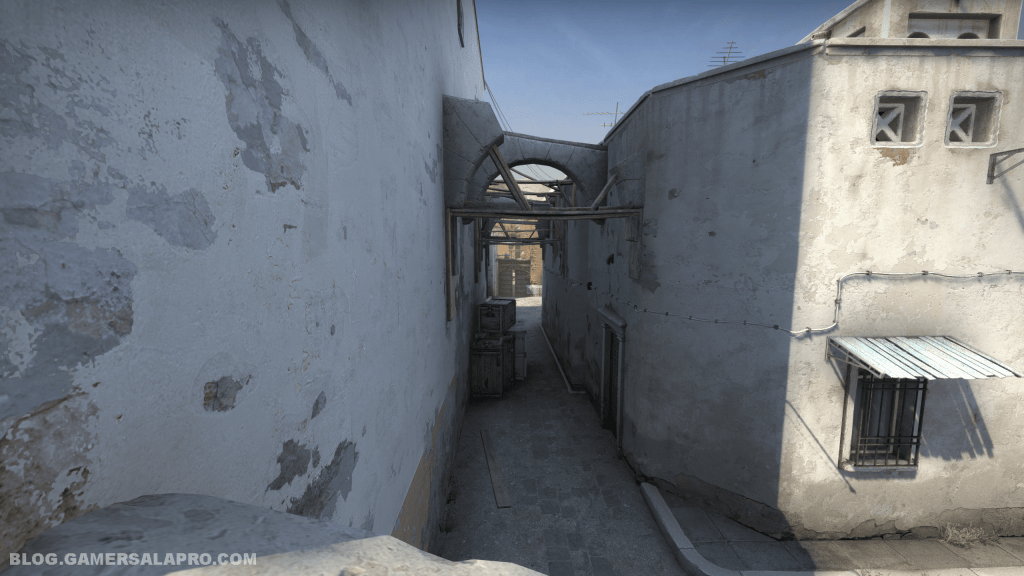

Terrorist’s Spawn: The blockage of “Suicide” (the corridor shown above) was considered a controversial, but ultimately solid change. Preventing Terrorists from having excessive sightlines into CT mid and harassing easily with Sniper Rifles:
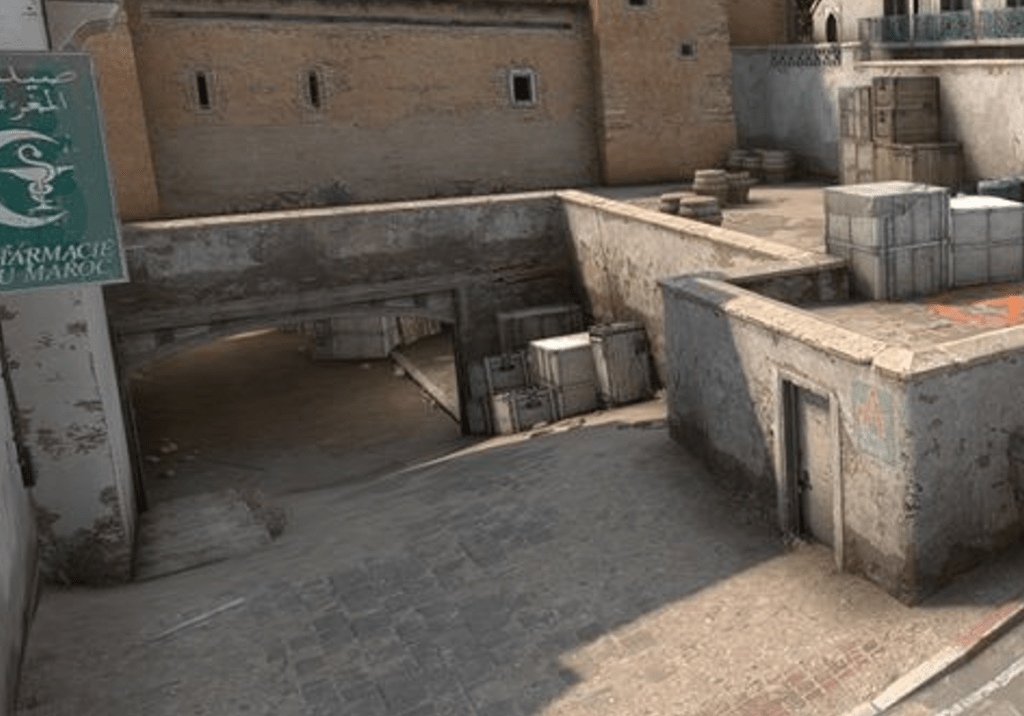
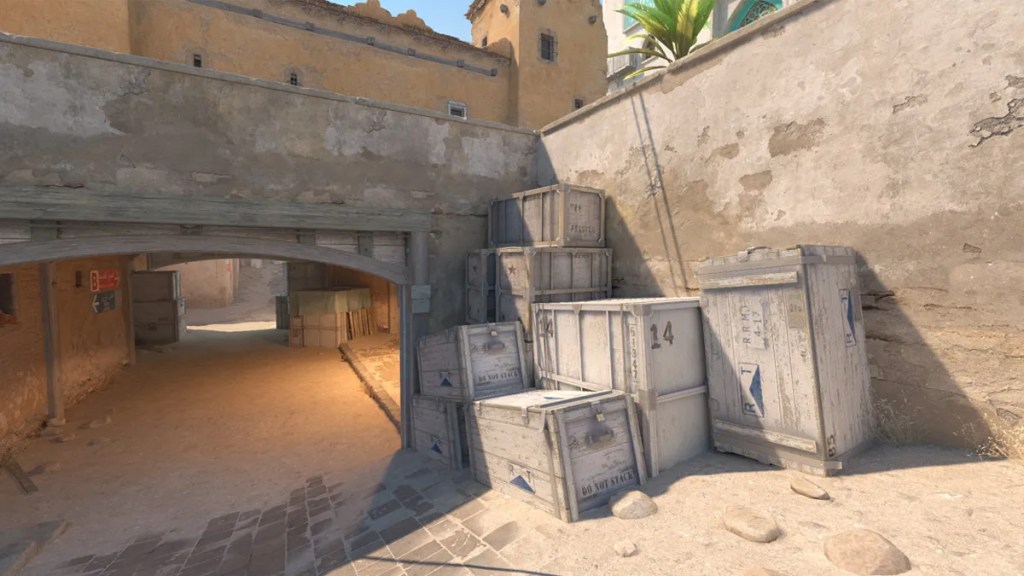
CT Spawn: CTs no longer require a team-mate to boost them up to “cat-walk“, and can reach it without assistance, as well as adding another route for Terrorists to retake the site. A solid change that improved the somewhat limited flow into A site from CT spawn. Check out the video below for a breakdown:
This is a first pass on this article, and I hope to update it in the near future – stay tuned!
-Will
 LEVELDESIGN.XYZ